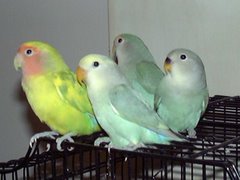
show king Mas 10 for sale......

|


please contact me....o199919651..
harga boleh runding.

Lovebirds Conjuctivitis

|
Lovebirds Conjuctivitis

Do you know there is 30% mortality among lovebirds due to conjuctivitis? (Source:Science direct) So it is mandatory get to know about the disease conjuctivitis in lovebirds. The main symptoms of conjuctivitis in lovebirds include lacrimation, whitish thick mass at the corner of the eye, anorexia and ruffled feathers. In severe cases, red, swollen, watery, or crusty eyes; sometimes the eyes are so swollen or crusted over that the birds.

Causes for Lovebird Conjunctivitis

The main causative factors for this condition includes protozoa, nematodes, fungi, bacteria and injuries. You can confirm the cause for the conjunctivitis only by performing diagnostic tests.

How To Cure?

Don't go for any natural remedies to cure this disease in lovebirds because Chances are the bird would be dead before they could take effect. Enrofloxacin, Doxycyclin, or erythromycin are the best drug of choice for treating this condition. But consulting an avian vet to treat your lovebirds is highly recommended.

After giving antibiotics it is always being advised to give after any antibiotic treatment for control lovebirds conjunctivitis.

Hatching lovebird eggs

|
Most of the lovebird owners (Newbie) are really don't know when their lovebirds will lay eggs. Normally a female lovebird will start to lay eggs after 10 months of age. Breeding lovebirds is very EASY task for the lovebird breeders. But it is very difficult to find a new home for the young ones because the young ones can't be placed along with their parents for a long period.

The hatching period of lovebird eggs is usually 18-20 days of hatch. The clutch size would be 4-6 eggs. Both male and female will nest the eggs in a phased manner. It is not advisable to perform nest inspection because both the parents would be aggressive. If you're so keen to see the eggs, it always advisable to see the nest only after both parents are away from the nest.

If you want to hand feed the young chicks, it is advisable to pull hem out from the nest only after two weeks old.
For further information, please consult the following pages:
1. Menu For Your Weaned Lovebird Chicks
2. What do you Feed For the Peach-faced Lovebirds?

How to control feather plucking in lovebird

|


Have you ever noticed few missing feathers in the crests of wings or breasts of your lovebirds? Then, you should keenly watch your lovebirds for feather plucking. Although this falls under behavior and health, you should be carefully analyze the reason for feather plucking in lovebirds.

Initially feather plucking might have started innocently. But you should nib this problem in the bud itself. Otherwise it will cause your lovebirds complete bald. Then it is really difficult to bring back the colored feathers.

Feather picking among breeding pairs is a common phenomena. A hen lovebird will often clear few hairs on her belly, which is called as brood spot and also pluck few feathers from her mate's head as a mark of mating behavior among themselves.

The other reason for feather picking is hormonal issue. Lovebird pyoderma is the condition which occurs due to hormonal imbalance. If you're having a single lovebird, this is a major problem because it has no outlet for his/her energies.

Rule out the skin infection by examining the skin scraping on microscope. If they suffer from any skin infection- bacteria or fungus, immediately contact your avian veternarian to treat the condition.
Anxiety, frustration and boredom may also lead to feather plucking in lovebirds. There was lovebird which started to pluck its feather after fixing a photograph just in front of her cage. Removing the photograph solved the problem. Who knows what made that poor creature to get more anxious after seeing that particular photograph.

Treatment

Find out the cause for the feather plucking and remove the same at the earliest possible time. Don't use styptic powder in the wound as it would aggravate the condition. Do use diluted betadine solution to clean the wound. More over, don't treat the lovebird on your own. Please do seek an appointment form your avian vet to completely get rid of this problem. ALL THE BEST!!!

Lovebird illness: Learn the Symptom of Lovebird Illness

|


Lovebird illness: Learn the Symptom of Lovebird Illness

Lovebirds are really skilled in hiding the symptoms of disease/illness because showing their illness in nature will help the predators to attack them. In order to have the best chance of saving the life of lovebirds, you should lookout for telltale symptoms of sick lovebird.

Early signs of lovebird illness include change in feeding habit, overly quiet, and fluffed feathers. Once your bird shows any of these symptoms, you should approach an avian vet as early as possible to avoid any untoward incident.

The symptoms of lovebird's illnesses are the sequel of some of the lovebird's diseases. Some of the common diseases/ conditions that pave way for sickness are enteritis, respiratory disorders, coccidiosis, intestinal influenza, egg drop syndrome, ticks, mites, internal parasites, bacterial and viral infection (avian pox, polyoma viral, etc), yeast infections (candidiasis) and infighting.

Once your lovebird have shown symptoms of running nose, reduced appetite, dull or watery eyes, sleeping in their enclosure with eyes closed, dull plumage, ruffled feathers cloudy eyes, and soiled vent, you may come to conclusion that your lovebird is going towards the sickness.

Some of the sick lovebirds love to stay near the feeding cup. Even falling from the perch, excessive scratching, sneezing, labored breathing, and tail bobbing are the final symptoms of lovebird illness.

As a responsible lovebird owner, once you found illness in your lovebird, an avian vet check should be the FIRST thing you do! It is always advisable to catch sicknesses first, to be safe than sorry, rather than realize it once it is beyond the reach of the vet.

Lovebirds in Your Garden

|

The Lovebirds

The Lovebirds


Lovebirds in Your Garden

Lovebirds are also ideal subjects for the garden. They need a secluded shelter in which to roost. Newly imported birds must spend their first winter in a minimum of 15 degrees celcius (59 F). In the summer, it is best to have nest boxes, where it is moister. In the winter, they should be placed in the shelter.

You can keep several pairs in a wooden aviary, as long as they are all placed in it together. Later, remove any surplus males or females. Two birds occupying a nest box are not necessarily a breeding pair; sometimes two males, or two females, pair up. As a rule, any superfluous birds sleep alone in a box. You can close up all the entrance holes in the dark, and in the morning discover where the isolated birds are. Of course, you must have enough boxes, all hung at the same height.

From four to six eggs are usual, incubated by the female for twenty-one to twenty-five days, depending on the species. The young leave the nest after four to six weeks and are fed, mainly by the male, for a further two weeks. Once they are independent, remove them, because they will cause problems when the parents breed again and maybe attacked by them.

Young birds mature at around ten months. You will always have more females than males. If you are keeping species together, hybridizing may occur. This is not recommended.

HOW TO CARE LOVEBIRDS

|
Do you know all the wild birds will mask signs of sickness as a way of existing? So, once your lovebird exhibits signs of ill health such as sitting at the cage floor, mucus from nostrils and soiled vent. You ought to take care your lovebirds at this situation.

You should consult an avian vet immediately. The healthy lovebirds should have smooth feathers, clear bright eyes, normal stools, clear bright eyes, a healthy appetite, eating throughout the day, normal level of activity and a clean vent.

Wings Trimming

Next step in caring lovebirds involve trimming of the wings. If you are an experienced bird handler, you may use wing-clipping scissors that are designed specifically for this application. Or trimming process should be performed by an avian vet to prevent any problems.

Nail trimming

Most of the lovebird owners may ask how to care my lovebird's nail. In wild, the lovebirds will trim their nails and beak with rough branches of trees. In the captive conditions, you should provide cuttle bones and bird perches of a variety of textures in order to keep its beak and toe nails in good shape. Too long nails may be trimmed with the help of bird clippers. Be careful while trimming the nails as you severe up to the vein.

Cage care for lovebirds

Weekly cleaning of birdcages should be advocated regularly. Washing the birdcage with birdcage cleaners also being advised. A mixture should be prepared by mixing 1 gallon of water and ¾ cup bleach to disinfect the cage. Replace the good old cage parts made up of wood or wooden toys and perches as they may get dirt with droppings.

Caring lovebirds involves allowing them to let out of their cage daily as they have a exhaust their excess energy by flying. The lovebirds should be allowed to fly after closing all windows and also switch off the ceiling fans. Even you can use a bird leash to have more control over the birds while it is flying.